
9:41:15 a.m.
At 9:41 and 15 seconds on the morning of September 11, 2001, Associated Press photographer Richard Drew pointed his camera up at the North Tower of the World Trade Center and pressed the shutter. He was not trying to capture anything in particular — he simply held the camera up and tracked a falling figure as the motor drive cycled through frame after frame, the way he had learned to do decades earlier while photographing breaking news, including the assassination of Robert F. Kennedy in 1968. Of the eight or nine images in the sequence, one happened to catch the man in an almost perfectly vertical position: head down, one leg bent at the knee, arms close to his body, as if suspended rather than falling. Drew has since said he didn’t even register the image until he was back at the office, reviewing the day’s film frame by frame.
That single frame — now known simply as The Falling Man — became one of the most enduring images to come out of September 11.
The photograph
The man in the photograph has never been officially identified. He was one of the roughly 200 people who fell or jumped from the burning upper floors of the Twin Towers that morning, trapped above the points of impact with no way down and, in many cases, no way to survive the smoke and heat. New York’s Chief Medical Examiner classified all of the deaths that day as homicides and never compiled an official list of those who fell, which means there is no definitive record to check the photograph against.
Journalists have spent years trying to answer the question anyway. A Toronto Globe and Mail reporter first proposed that the man was Norberto Hernandez, a pastry chef at Windows on the World, the restaurant atop the North Tower — a theory his devout Catholic family rejected, insisting he would never have chosen to jump. In 2003, Esquire writer Tom Junod reopened the case at the request of Hernandez’s widow, hoping to clear her husband’s name. Working from the full sequence of Drew’s images, Junod noticed that in later frames the falling man’s shirt blows open to reveal a distinctive orange T-shirt underneath — a detail that didn’t match Hernandez but did match Jonathan Briley, a 43-year-old sound engineer at Windows on the World who stood six-foot-five and was known to wear black high-top sneakers and an asthma inhaler he depended on daily. Briley’s sister and former manager both said the man in the photo resembled him, though even Junod’s account has always been probability rather than proof. The man’s identity, in other words, remains formally unresolved. As one 2016 Time retrospective put it, his significance lies less in who he was than in what he became: an unintentional stand-in — an “Unknown Soldier” — for everyone who fell that morning.
The image ran in newspapers across the country and the world on September 12, 2001, including in The New York Times, and the reaction was immediate and hostile. Readers called it cold-blooded, ghoulish, exploitative — an intrusion on a man’s most private and terrible moment, broadcast to millions of strangers over breakfast. Within days, many outlets pulled it from circulation or declined to run it again. Television networks, which had captured similar footage live on September 11, largely stopped airing it after that first morning, following an unspoken but near-universal editorial consensus that the falling bodies were the one image of the attacks the public could not be shown on a loop.
Part of what made the photograph so hard to look at was its intimacy. There is no blood, no visible wreckage, none of the chaos that usually gives a disaster photograph the alibi of context. It is, as Drew himself has described it, “a very quiet photograph” — the man’s posture almost serene, arms at his sides, as though he had simply decided to dive. That composure is precisely what unsettled people: it asked viewers to sit with the fact that a human being, moments from death, could look like that. It also collapsed the distance journalism usually provides. Whether he jumped to escape unbearable heat and smoke, or lost his footing trying to reach a window for air, is unknowable — but the photograph forced the public to confront a fact that first responders and survivors already knew and that the country as a whole was reluctant to absorb: that people trapped above the fire faced an impossible choice, and some chose to fall rather than burn.
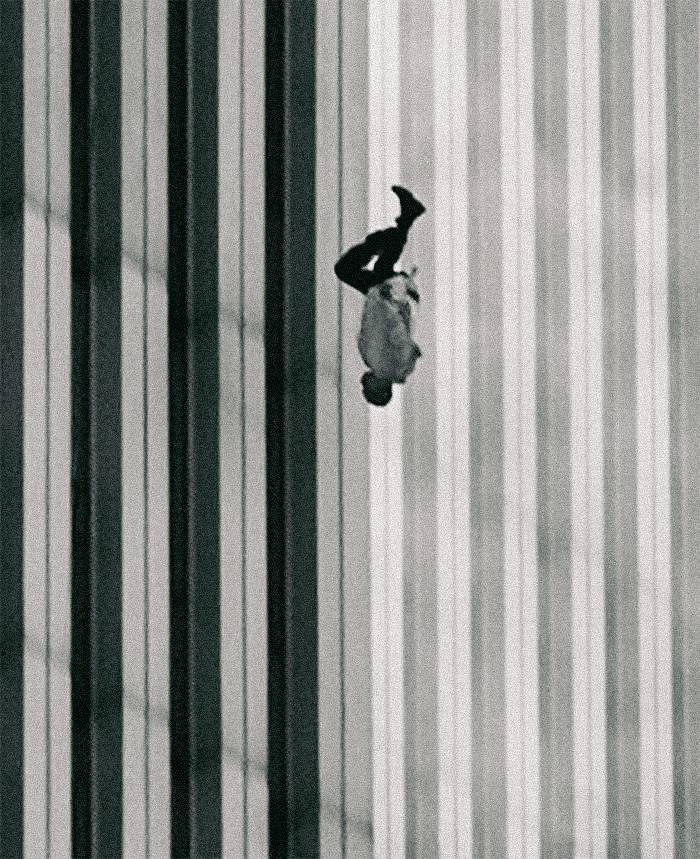
The photograph’s reputation has shifted with time. Musician Elton John later bought a print for his personal collection, calling it “the most beautiful image of something so tragic” and “one of the most perfect photographs ever taken.” Documentaries, museum exhibitions, and journalism-ethics courses have returned to it repeatedly, less to resolve the discomfort it provokes than to ask what obligations a photographer, an editor, or a viewer has toward an image like this. Drew has always maintained that his job that day was simply to document what happened, however difficult that record turned out to be to look at.
The Day it belongs to
The photograph exists inside a single, compressed morning of American history. At 8:46 a.m., American Airlines Flight 11 struck the North Tower between the 93rd and 99th floors, instantly severing stairwells and trapping everyone above the impact zone. At 9:03 a.m., United Airlines Flight 175 hit the South Tower. By the time Drew captured his image at 9:41 a.m., both towers had been burning for the better part of an hour, jet fuel-fed fires weakening steel that was never designed to withstand temperatures anywhere near what they were now facing. The South Tower would collapse at 9:59 a.m.; the North Tower, at 10:28 a.m. In under two hours, nearly 2,750 people died at the World Trade Center alone, alongside 184 at the Pentagon and 40 aboard United Flight 93 in Shanksville, Pennsylvania — roughly 2,977 deaths in total, the deadliest terrorist attack in history and the deadliest single incident for firefighters and law enforcement officers in American history.
For those trapped above the fire lines in both towers, the choice was never between safety and danger — it was between two forms of danger, with no good option on either side. Temperatures near the impact zones are believed to have exceeded 1,000 degrees Fahrenheit in places. Smoke inhalation, structural failure, and unbearable heat made survival above the fire floors effectively impossible once rescue routes were cut off. It’s in that context — not as an act of despair alone, and not reducible to any one motive — that the photograph has to be understood. The stillness of the man’s body is what makes the photo unbearable, but the stillness is also an illusion: the government’s own account of that morning describes people who “jumped” as making a desperate choice in the final minutes of lives that had already, in every practical sense, been taken from them by the attack itself.
DeLillo’s Falling Man: a single frame into a novel
Six years after the attacks, novelist Don DeLillo published Falling Man (2007), a novel that takes its title directly from Drew’s photograph and turns its central image into something stranger and more layered than reportage could allow. The book follows Keith Neudecker, a survivor who walks out of the towers covered in ash and glass and into the fractured life he shares with his estranged wife, Lianne, in the months and years that follow. DeLillo is less interested in plot than in the slow psychological aftershocks of the attack — how trauma reorganizes memory, intimacy, and the ordinary rhythms of a marriage and a city.
The novel’s main device is its literal “Falling Man”: a performance artist, later identified in the book as David Janiak, who stages unannounced public drops around New York, harnessing himself and plunging headfirst from bridges, train platforms, and building ledges, replicating the pose of the man in Drew’s photograph in front of startled crowds of commuters and bystanders. It’s a deliberately provocative artistic conceit — Janiak’s performances read simultaneously as tribute, protest, exploitation, and a kind of forced public reckoning, refusing to let the city look away from the image it had collectively agreed to stop showing. Characters in the novel react to him with the same mixture of horror and helpless fascination that greeted the real photograph in 2001: some see him as obscene, others as a necessary provocation, and DeLillo never fully resolves the tension between those readings.
Alongside Janiak’s performances, the phrase and image of the falling man recur throughout the novel as a psychological motif rather than a literal one — surfacing in Keith’s dissociated flashbacks, in Lianne’s obsessive researching of the performer, and in the fragmented, non-chronological structure DeLillo uses to represent trauma itself, which doesn’t move forward the way ordinary narrative does but keeps returning to the same unresolved moment. In this sense, DeLillo uses the “falling man” on two registers at once: as a real, embodied figure staged for shock and confrontation within the story, and as a recurring image of psychic free-fall that the novel’s characters — and by extension its readers — can’t stop replaying. The effect mirrors what Drew’s photograph did to the public in 2001: it forces a second look at an image everyone had tried to put away.
What connects the photograph and the novel is the same unresolved question: what do we do with an image, or a moment, too painful to look at directly but too important to look away from? Drew’s photograph was pulled from newspapers within days because readers couldn’t bear it; DeLillo’s novel, six years later, put a version of that same image back in front of readers deliberately, insisting that the discomfort itself was part of the historical record. Neither the photograph nor the novel offers closure — the man’s identity remains unconfirmed, and Janiak’s motives in the book are never fully explained. That refusal to resolve is, in both cases, the point.
About the Author



Your comment screams: I am a come-here and did not assimilate. Assimilation requires individuals to fully adopt the cultural norms,…
My goodness, who'd a thought it: Albany, New York Times Union 10 September 2026 Sheriff's investigator charged with misusing Flock…
No, they would have done it in the dead of the night, silently. You sir, are a damned fool.
Breaking News! Developing Story! Team Coverage! ..14 August 1996.. Loco men and their OffSpring go on Rampage breaking glass, pulling…
Matthew 6:24 24 “No one can serve two masters. Either you will hate the one and love the other, or…