
CAPE CHARLES, Va. — More than a week after raw sewage poured into town streets and storm drains following a pump station failure, questions remain about whether contamination reached Cape Charles Beach — and about how quickly anyone would know if it had.
The spill
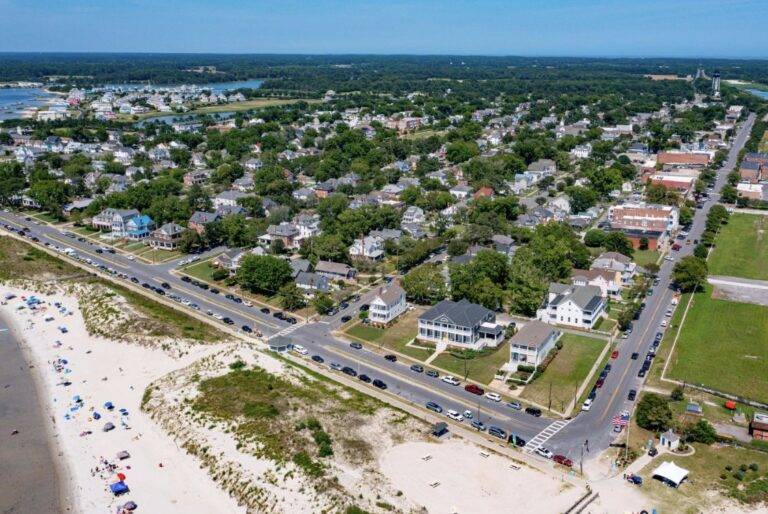
The trouble began the evening of Friday, July 3, when the Mason Avenue Pump Station went out of service, sending raw sewage backing up into roadways and sidewalks around Mason Avenue, Harbor Avenue and Bay Avenue. The town closed portions of those streets to vehicles and pedestrians and asked residents to limit toilet flushing while Virginia American Water crews worked through the night and into Saturday to make repairs. By July 4, the utility had restored the pump station and use had returned to normal.
By some estimates, more than 7,000 gallons of raw sewage reached town streets and storm drains before the failure was resolved.
Heavy rainfall Thursday night could cause contamination issues at the beachfront.
Why storm drains matter
Cape Charles’ storm drain system is built to carry rainwater off streets, parking lots and roofs and route it — untreated — straight to the nearest waterway. That is by design: storm sewers are not connected to a treatment plant the way sanitary sewer lines are. Under normal conditions, that runoff carries little more than road grit and leaf litter. But when raw sewage spills onto pavement, as it did on Mason, Harbor and Bay avenues, it has a direct, unfiltered path into the same drains — and from there, into the waters off Cape Charles Beach.
Heavy rain makes the problem worse in two ways. It flushes whatever sewage is sitting on the street into the drains faster and in greater volume, and it adds its own load of bacteria and pollutants picked up from lawns, roads and animal waste along the way. Public health agencies across the country — from Virginia Beach to Los Angeles to New York — routinely warn that bacteria levels near storm drain outfalls spike during and after storms, sometimes for as long as 48 to 72 hours.
A weekly testing schedule with a blind spot
That timing is where Cape Charles’ monitoring system runs into trouble. The Eastern Shore Health District tests the public beach for bacteria once a week, on Tuesdays. Health district officials say they lack the staffing and resources to sample outside that fixed schedule or in direct response to a storm or a spill.
That means if contamination from the sewage spill and the accompanying rain washed into the beach on a Wednesday, Thursday or Friday, it could come and go without ever showing up in a water sample — and without the public being notified. Bacteria commonly used as indicators of fecal contamination, such as enterococci, do not linger indefinitely; levels that spike after a rain event or a spill can fall again within a few days, well before the next scheduled Tuesday test.
A pattern seen elsewhere
Cape Charles is far from alone in facing this gap. Coastal communities nationwide have struggled with the same math: routine beach monitoring is typically weekly, but contamination from storm drains, sewer overflows and failing infrastructure often peaks and fades faster than that testing cycle can catch. Health departments in places like Massachusetts, New Jersey, New York and California have all issued advisories after storms specifically because runoff analysis showed elevated bacteria tied to stormwater outfalls — and public health officials in those states routinely advise swimmers to stay out of the water for one to three days after heavy rain, particularly near drain pipes and outfalls, regardless of whether a formal advisory has been posted.
Symptoms linked to swimming in bacteria-contaminated water can include gastrointestinal illness, skin rashes, and ear, eye and sinus infections — risks that rise for children, older adults and anyone with a weakened immune system.
What residents can do in the meantime
Until testing schedules or capacity change, public health guidance elsewhere offers a few precautions for Cape Charles Beach visitors:
- Avoid swimming for 24 to 48 hours after any heavy rain, especially near storm drain outfalls.
- Watch for discolored, murky or foul-smelling water, or visible debris — signs of possible contamination that predate any official test result.
- Keep children and pets away from puddles or runoff pooling near storm drains, which can carry higher bacteria concentrations than the open water itself.
- Avoid swimming with open cuts or wounds, and avoid swallowing water.
Residents with questions about beach water quality can contact the Eastern Shore Health District directly. Town officials have not indicated whether additional testing or infrastructure repairs are planned in response to the Mason Avenue spill.
This story will be updated as more information becomes available.
About the Author



Of course it's his business how much water the concrete plant uses. This is still America, afterall. And where are…
It is none of your damn business how much water the concrete plant uses. You seem like a busy body.…
According to the Cape Charles Mirror (10/11/26), in the article on “Cape Charles Advances Municipal Building, Harbor Boardwalk and Infrastructure…
Thank you very much for your prompt edit 😊
You’ve posted a photo of Eyre Hall. This can be very misleading. Please correct. Editor's Note: Thanks for the catch!…