
Anthropic’s newest model now completes about two in five real freelance jobs to a client’s standard, nearly double any rival, on the benchmark built to track AI’s reach into paid remote work.
Claude Fable 5.2 has taken the top spot on the Remote Labor Index (RLI), a benchmark that hands AI agents real projects commissioned on Upwork, with an automation rate of 41.3%. That means expert graders judged its deliverable at least as good as the human freelancer’s, the standard a reasonable client would accept, on 41.3% of projects.
The gap to the field is wide. Anthropic’s own Claude Opus 5.5 is second at 21.25%, and OpenAI’s GPT-6 Astra is third at 20.83%, according to The Decoder’s report on the leaderboard. Google’s Gemini Argon 4 follows at 17.08%.
| Rank | Model | Developer | Automation rate |
|---|---|---|---|
| 1 | Claude Fable 5.2 | Anthropic | 41.30% |
| 2 | Claude Opus 5.5 | Anthropic | 21.25% |
| 3 | GPT-6 Astra | OpenAI | 20.83% |
| 4 | Claude Fable 5.1 | Anthropic | 17.92% |
| 5 | Gemini Argon 4 | 17.08% |
Leaderboard as of Nov. 10, 2026, via explainx.ai and AI Weekly.
The ranking comes from the benchmark’s operators, Scale Labs and the Center for AI Safety (CAIS), which maintain the public RLI leaderboard. Anthropic released Fable 5.2 alongside Claude Mythos 5.2 on Nov. 9, SiliconANGLE reported; the two are configurations of the same underlying model, with Fable carrying extra safeguards.
Anthropic’s launch benchmark table also listed 41.3% on RLI at High effort, explainx.ai and LLM Reference noted. The Scale and CAIS leaderboard now confirms that figure independently. Anthropic has not commented on the result beyond that table.
Fable 5.2’s largest gains came in audio and music editing, architecture and interior design, and 3D modeling, according to the Scale Labs writeup reported by The Decoder. Nearly 50 of its successful jobs were ones no agent had completed before, Silicon Report noted.
Other work remains out of reach. Scale Labs said the model can “still barely handle” industrial product design and animation. Typical failures were:
- Amateur-quality work a paying client would reject
- Incomplete or broken files
- Designs that contradicted themselves or the brief
RLI’s 240 projects came from 358 verified Upwork freelancers and are worth about $144,000 in total. Each averages $632.60 and just under 29 hours of human work, spanning video editing, CAD, game development and data analysis.
Agents work in a virtual desktop with professional tools such as Blender, GIMP and Audacity. They get the same brief the human freelancer received.
Grading is done by people, on purpose. Trained experts open each submission in the relevant software and compare it with what the freelancer delivered. Three reviewers score each project on a three-point scale, and a 2 (“meets”) or 3 (“exceeds”) counts as success; Scale reports 94.4% agreement between reviewers.
CAIS has tried to automate grading with AI reviewers, without success so far. The reviewers struggled to operate the professional software and graded too generously, The Decoder reported, including being fooled by work that looked polished but was technically flawed.
Leaderboard scores use 230 private projects; 10 are public. Scale publishes no confidence interval for the automation rate.
From 2.5% to 41% in about a year
The top score has risen more than sixteenfold since the benchmark launched, and most of that jump came in the last two months.
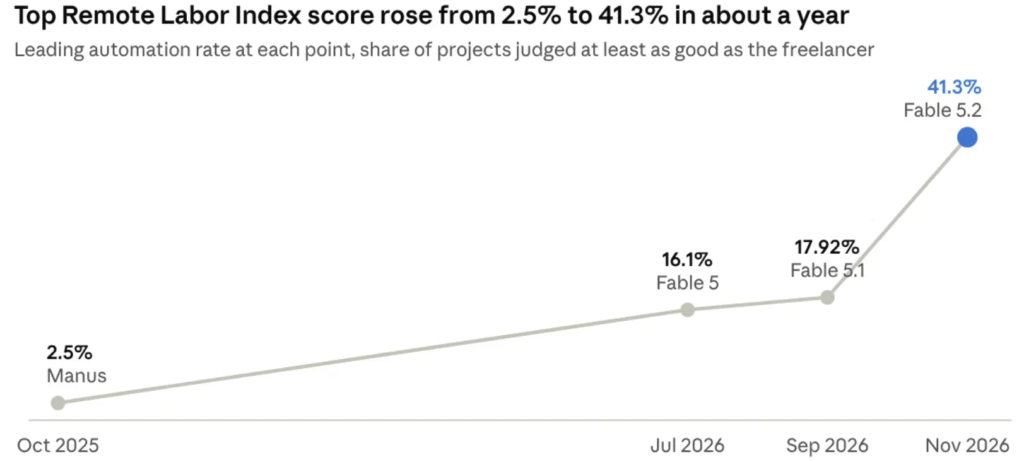
When the RLI paper was published in October 2025, the best system, Manus, completed 2.5% of projects. Fable 5 took the lead at 16.1% in July 2026, The Decoder reported, though it was scored on 218 of the 240 jobs; counting the missing 22 as failures gave 14.6%. The live leaderboard now lists it at 15.83%.
Its direct predecessor, Fable 5.1, released in September, scored 17.92%. Fable 5.2 more than doubled that in roughly two months.
The score measures project completion on a fixed sample of jobs. It does not estimate what share of the remote labor market AI can automate.
RLI’s designers left out work that needs live back-and-forth with a client, such as tutoring, or that a team must run together, such as project management. A 41.3% rate on the projects that remain is not a claim that 41.3% of freelance work is automatable.
The lack of a published confidence interval also matters for close rankings. Opus 5.5 and GPT-6 Astra are separated by 0.42 percentage points, roughly a single project.
Sources
- Remote Labor Index leaderboard, Scale Labs and CAIS
- Remote Labor Index: Measuring AI Automation of Remote Work, Scale Labs, Oct. 28, 2025
- Anthropic’s Fable 5.2 Clears 41% of Real Upwork Projects, AI Weekly summarizing The Decoder, Nov. 10, 2026
- Remote Labor Index: What Fable 5.2’s 41.3% Automation Rate Actually Measures, explainx.ai, Nov. 10, 2026
- Anthropic’s Fable 5.2 leads Remote Labor Index with 41.3%, Silicon Report
- Remote Labor Index benchmark page, LLM Reference
- AI agents can now complete 16 percent of freelance jobs at pro quality, The Decoder
- Remote Labor Index automation explainer, Pebblous
- Anthropic launches Fable 5.2 and Mythos 5.2, SiliconANGLE, Nov. 9, 2026
About the Author




Debbie Lewis says @:November 13, 2026 at 8:25 pm: Mr. Plante, Honestly, all I’ve been feeling for you is sincere…
Mr. Plante, I’m not an eloquent writer so I’ll keep it brief. I too am a senior citizen. Honestly, all…
Thoughtful analysis Wayne. I might add that those in public office should refrain from appearances of impropriety so that links…
Bro - these elected leaders are clowns. Look at the article on the Mayor in this week's Mirror. The fact…
Cape Charles officials seem to be much more concerned with the wishes of the developers than the wishes of the…