
69 A.D.: Roman General Vespian, one of the key captains of the Roman invasion and subjugation of Britain, and later the head of the Legions that crushed the First Jewish Rebellion, arrives this day in Rome to begin a political campaign that will culminate in him being declared Emperor.
69 A.D.: One day after entering Rome, the Roman Senate declares Vespian Emperor of the Roman Empire, the fourth one in The Year of Four Emperors.
72 A.D.: Traditional date for the martyrdom of the apostle Thomas, who spent his life after the Resurrection traveling east from the Roman Empire, spending twenty years introducing Christianity to the people of India.
1118: Birth of Thomas Beckett (d.1170), Archbishop of Canterbury.
1192: On his way home to England after concluding the Third Crusade, Richard I Coeur de Lion, is captured and held prisoner by Leopold V of Austria, on the pretext of some sort of slight to the banner of Austria during the Crusade’s siege of Acre. Leopold demanded a literal King’s Ransom from England before he would set him free. After two years of crushing taxation & confiscations back in the Auld Sod, Richard’s kingdom successfully delivered the required 150,000 marks (~57,000 actual pounds of silver (around L2bn in today’s money)), and Richard continued home to put the usurper Prince John back in his box.
1620: After five weeks of surveying the shoreline of Cape Cod Bay, the Pilgrims come ashore at Plymouth Rock to begin their first permanent settlement. The group split their time between the building parties ashore and recuperating aboard the Mayflower, with no fewer than 20 men kept always ashore for defensive purposes. The basic work plan was viable, but this first winter in the New World was brutal, with exposure, scurvy and other diseases claiming nearly half of the settlers who survived the treacherous voyage to their new life.
1776: After a treacherous overnight crossing from Pennsylvania across an ice-choked Delaware River, General George Washington leads 2,400 Continental Army troops into action against Hessian mercenaries stationed in Trenton, N.J. The Hessians, caught completely off-guard by the attack, put up a short, sharp resistance and fighting withdrawal from their initial positions north of the city. But after several moves and counter-moves, the Hessian commander realizes the Americans have completely cut off all chance of escape or reinforcement, and surrenders his 1,500 professional troops to Washington. The victory galvanizes American support and morale throughout the colonies, and confirms Washington’s unique effectiveness in exploiting the strengths of the relatively weak Continental Army against the potential weaknesses of his enemies.
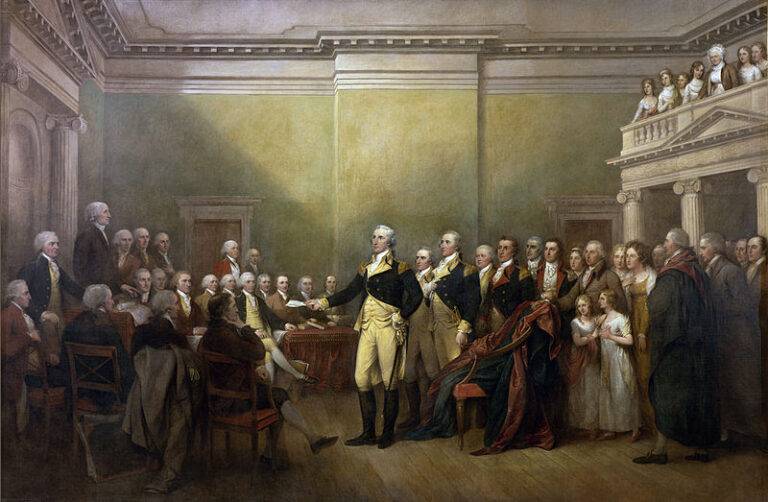
1783: In an unprecedented demonstration of self-abnegation, General George Washington resigns his commission as Commander in Chief of the Continental Army, an act that stunned the aristocracy of Europe, and caused none other than King George III to declare him “the greatest character of the age” because of it. The event was memorialized by a massive portrait by the great John Trumbull, which now hangs in the rotunda of the U.S. Capitol.
1807: At the request of President Thomas Jefferson, Congress passes the Embargo Act, cutting off all American trade with both Great Britain and France. The act grew out of increasing American exasperation over ship seizures committed by both sides of the renewed Napoleonic wars. Jefferson’s explicit goal was to conduct “economic warfare” with the two European superpowers as punishment for both countries considering American ships and cargoes as contraband of war, rather than neutral trade. Britain, in particular, took not only ships, but American seamen as well, impressing them (i.e., legally kidnapping them) into the chronically under-manned Royal Navy. The Act did its work to halt American shipping in its tracks, which by extension caused Southern agriculture to rot for lack of European markets, for Northern manufactured goods to gather dust in warehouses, for thousands of ships to be laid up without maintenance, for American companies to go bankrupt, and for a crippling recession to set in across all the States. British and French shippers immediately took up the slack on formerly American trading routes, particularly through the Caribbean and South American markets, and got rich. Black marketeering through Canada became endemic, and widespread disgust at the Federal government’s high-handedness led to massive resistance, particularly from the business interests in New England. The Act was repealed two years later, but by then the damage was done to the credibility of Jefferson’s ideal of limited government versus his doctrinaire big government approach to enforcing a decidedly intellectual solution to the economic depredations of the French and English. Even after repeal, the issues on both sides of the Atlantic continued to fester, leading to yet another embargo attempt in 1812, and eventually, war with England.
1808:Ludwig von Beethoven personally conducted the premieres of his 5th and 6th Symphonies, in addition to playing the piano for the premiere of his 4th Piano Concerto and the Choral Fantasy. The concert itself lasted 4 hours, and although there was the usual kvetching about it being too cold in the theater, the reality of what happened that night remained seared in the memories of those who attended, particularly the musicians who came to realize the stupendous power and lasting impact of Beethoven’s work.
1809: Birth of legendary frontiersman, trapper, Indian fighter, scout and soldier, Kit Carson (d.1868).
1814: British and American diplomats sign the Treaty of Ghent, formally ending the War of 1812. The terms of the agreement essentially return the belligerents to the status quo ante bellum, which reinforces the notion that this two-year long conflict, never politically popular nor strategically coherent, really was a wasted effort in lost political will, lost commerce, and lives. On the positive side, the US naval victories at sea and the astonishing victory at the Battle of New Orleans convinced Britain that although they need not become close allies with the United States, they now respected us as legitimate power players on the international stage.
1856: Birth of Frank B. Kellogg (d.1937), U.S. Representative and Senator from Minnesota, and later Secretary of State for Presidents Coolidge and Hoover. He was the namesake negotiator for one of the more esoteric pieces of international diplomacy, the 1928 Kellogg-Briand Pact, which outlaws war as an instrument of national policy, and for which he was awarded the Nobel Peace Prize in 1929.The treaty remains in effect to this day.
1864: Birth of Harvey Firestone (d.1938), founder of the Firestone Tire and Rubber Company.
1864: Five weeks after taking his leave from the smoldering ruins of Atlanta, Union General William T. Sherman telegraphs President Lincoln with the news of his capture of the port of Savannah, Georgia. “I beg to present to you a Christmas gift the city of Savannah, with one hundred and fifty guns and plenty of ammunition, and also about twenty-five thousand bales of cotton.”
1872: Under the sponsorship and direction of the Royal Society, HMS Challenger sets sail from Portsmouth to begin a three-year, 70,000-mile voyage of science and discovery. Unlike previous expeditions during the great age of discovery in the centuries prior, this expedition was designed around specific oceanographic scientific research that could answer questions about what lay below the depths of the lead line. The effort was staggering. Wikipedia summarized it as: “492 deep sea soundings, 133 bottom dredges, 151 open water trawls and 263 serial water temperature observations were taken. About 4,700 new species of marine life were discovered.”
1898: Concluding a stunning year of experimentation and discovery on the properties of radioactivity, Marie and Paul Curie announce the isolation of Radium, the central element of their comprehensive analysis of uranium, X-rays, and other naturally occurring “electrical” transmissions, which they recognized as fundamentally different than electricity, and for which they coined the term “radiation.”
1901: Birth of American physicist Robert Van de Graaff (d.1967), best known for designing and building high voltage DC generators that bear his name.
1905: Birth of movie mogul, aircraft designer, pilot, businessman and legendary eccentric, Howard Hughes (d.1976).
1913: President Woodrow Wilson signs into law the Federal Reserve Act, which establishes the Federal Reserve, creating a U.S. Central bank. The “long title” of the law, helpfully included with the Wikipedia entry, reads: “An Act to provide for the establishment of Federal reserve banks, to furnish an elastic currency, to afford means of rediscounting commercial paper, to establish a more effective supervision of banking in the United States, and for other purposes.”
1914: Five months into the widely spreading combat of the Great War, and just weeks after completing the “Race to the Sea” that established a continuous line of trenches from the Swiss border to the North Sea, on this Christmas Eve, soldiers from both sides of the trenches find themselves singing Christmas carols to each other, and then tentatively, but with increasingly greater frequency, climbing out of their trenches under an unofficial truce to exchange cigarettes and small gifts with soldiers from the other side. Christmas Day began a generalized truce that saw not only light fraternization, but also several episodes of soccer games between British and German soldiers in No Man’s Land. The Christmas Truce was a completely spontaneous and un-authorized pause in the fighting that the soldiers who were there remembered for the rest of their lives. In subsequent years, particularly after the shocking bloodletting and gas attacks of 1915, there was little need for the commanders on both sides to remind their soldiers that their job was to kill, not socialize with, the enemy on the other side of the trenches.
1919: Boston Red Sox first baseman George Ruth is sold to the New York Yankees.
1924: Former corporal and continuing Socialist agitator Adolf Hitler is released from Landsberg Prison, where he spent a year plotting his comeback and dictating his magnum opus, “Mein Kampf.”
1937: Opening night for Walt Disney’s Snow White and the Seven Dwarfs, the world’s first full length animated feature.
1938: In South Africa, discovery and documentation of the first “modern” coelacanth, a fossil fish long believed to be extinct.
1941: A group of American Army, Marine and Navy pilots form a fighter squadron to assist Chinese resistance against the continuing Japanese onslaught of that country. The American Volunteer Group led by the irascible Colonel Claire Chennault, flies the P-40 aircraft, decorated with the famous shark’s teeth, and immediately establish a shockingly effective record of kills against the Japanese.
1943: American General Dwight D. Eisenhower is named Supreme Commander for the Allied invasion of Normandy. Ike’s extraordinary skills in planning and diplomacy with the fractious British and French allies were the key to creating a success from this incredibly complex operation.
1944: A week into the German onslaught through the Ardennes Forest, which created a huge salient splitting the Allied drive toward Germany, the local Wehrmacht commander sends a team under the white flag to dictate surrender terms to the completely surrounded American force defending Bastogne. The American commanding general, Anthony McAuliffe, gave the German delegation a memorable sendoff: after hearing their terms, he looked them in the eye, snarled “Nuts!” and walked away from the astonished Nazis.
1944: Just days after General McAuliffe’s dismissal of German surrender conditions, Lieutenant General George S. Patton’s Third Army breaks through the encircling German lines to relieve the American garrison in Bastogne.
1946: Opening night for It’s a Wonderful Life.
1963: The Beatles release their first two musical cuts for the American market. The songs “I Want to Hold Your Hand” and “I Saw Her Standing There” may just be ridiculous pop music in the ears of some of our parents, but they represented the opening salvo of Beatlemania and the great British Invasion of the 1960s.
1968: Launch of U.S. astronauts Frank Borman, Bill Anders and James Lovell aboard Apollo 8, the first manned mission to leave the gravitational control of the Earth. Two and a half hours and three orbits after launch, Borman re-ignites the third stage (S-IVB) of the Saturn V rocket for a flawless Trans-Lunar Injection, beginning the two and a half day voyage to the Moon.
1968: Three days after making their trans-lunar injection (TLI) rocket firing, the astronauts of Apollo 8 fire their Service Module’s main engine and enter a stable lunar orbit. If you were sentient at the time, you will remember the stunning live color TV transmission* from the Command Module, when we earth-bound travelers witnessed with the astronauts the first “earth rise” over the limb of our celestial partner, punctuated with breathtaking poignancy as Mission Commander Frank Bormann read the opening verses of the Book of Genesis: “In the beginning, God created the heavens and the earth…” Jim Lovell and Bill Anders took turns with subsequent readings of the Creation story, closing with, “…and from the crew of Apollo 8, we close with good night, good luck, a Merry Christmas and God bless all of you – all of you on the good Earth.”
1970: The north tower of the World Trade Center is topped off at 1,368 feet, making it the tallest building in the world.
1988: A bomb placed aboard a Pan American 747 by Libyan terrorists explodes over Lockerbie, Scotland, killing all 270 souls aboard.
1989: American forces launch Operation Just Cause, an invasion of Panama, to overthrow the drug kingpin and nominal dictator, Manuel Noriega, who is captured and whisked off to Florida for trial and imprisonment.
1989: Surrounded by joyously chanting and singing Germans from both sides of the Wall, the Brandenburg Gate re-opens to two-way travel in Berlin, effectively ending the division of East and West Germany.
2001: Self-identified Islamic jihadist Richard Reed, tries to ignite his explosive-filled shoes on American Airlines Flight 63 over the mid-Atlantic between Paris & Miami. Alert passengers wrestle him to the deck and subdue him. He is convicted of eight criminal counts of terrorism, attempted murder, and will remain in the Colorado supermax prison until he dies.
About the Author



Based on what we have read, no one has, attempted to scare you or intimidate you. All of us are…
For someone that's against what I'm doing, you gave yourself away that you've READ IT ALL, only way you'd know…
And how old are those of you acting like middle school bullies? I tell it like it is. You obviously…
WRONG ‼️GENTRIFICATION IS VERY PURPOSEFULLY PERSONAL‼️
You really need to stop the name calling. You are actually older than Adam Hamilton's mother. So maybe you need…