
For decades, the world’s computing infrastructure has been firmly rooted on Earth. Vast warehouses filled with servers consume enormous amounts of electricity and require sophisticated cooling systems, often placing additional strain on local power grids and water resources. Now, SpaceX is proposing a radically different approach: moving the data center into outer space.
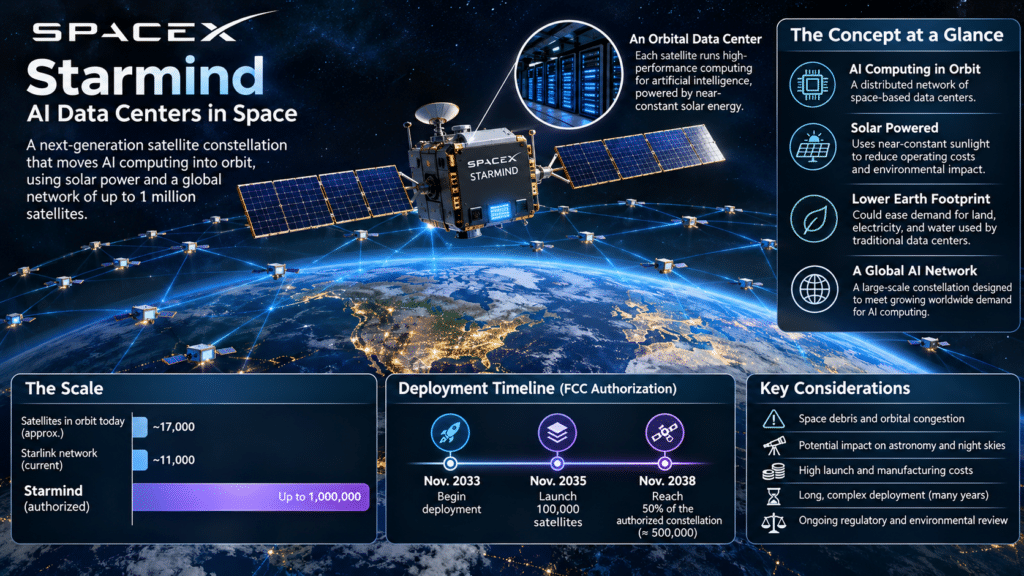
On Wednesday, the Federal Communications Commission authorized SpaceX to deploy up to 1 million satellites as part of a proposed constellation known as “Starmind,” an ambitious network of orbital data centers designed to accommodate the rapidly growing demand for artificial intelligence computing.
The proposal represents a potentially transformative shift in how the world builds and operates its digital infrastructure. It also raises significant questions about the commercialization of space, environmental stewardship and the future of the night sky.
As artificial intelligence becomes increasingly integrated into business, science, manufacturing and everyday life, the demand for computing power continues to accelerate. Technology companies are investing billions of dollars in terrestrial data centers, creating growing competition for electricity, land and water.
SpaceX believes part of the solution may lie hundreds of miles above the Earth’s surface.
The company argues that satellites operating in orbits with near-constant exposure to sunlight could harness solar energy to power advanced computing systems, potentially reducing operating costs and the environmental footprint associated with traditional data centers.
Orbital computing could also reduce dependence on terrestrial electrical grids and water-intensive cooling infrastructure. However, removing the enormous amounts of heat generated by high-performance processors presents its own engineering challenges in the vacuum of space.
The concept would effectively turn portions of Earth’s orbit into a distributed computing network, extending the infrastructure of the digital economy beyond the planet itself.
The sheer size of the proposed network is staggering.
Approximately 17,000 satellites currently occupy Earth’s orbit, according to the figures accompanying the proposal. SpaceX’s Starlink broadband network accounts for just over 11,000.
A constellation of 1 million satellites would dwarf anything humanity has previously placed in space.
The FCC authorization, however, does not mean that a million satellites will be launched anytime soon. Under the deployment schedule, SpaceX must:
- Begin deployment by November 2033.
- Launch 100,000 satellites by November 2035.
- Deploy 50 percent of the authorized constellation by November 2038.
Satellite operators frequently seek authorization for considerably more spacecraft than they ultimately deploy. SpaceX previously sought permission for approximately 42,000 Starlink satellites before building out its broadband network.
Much of Starmind’s feasibility will depend on Starship, the company’s massive reusable rocket system. SpaceX would need to dramatically reduce launch costs while achieving an unprecedented level of launch frequency and reliability to make orbital data centers economically competitive.
Not everyone shares SpaceX’s enthusiasm.
Amazon’s competing satellite division has questioned the practicality of the proposal, suggesting that deployment could take centuries under some launch-rate assumptions.
Astronomers and space scientists have also raised concerns about orbital congestion, satellite collisions, space debris and interference with astronomical observations.
Even relatively small pieces of debris traveling at orbital velocities can severely damage spacecraft. Collisions can generate additional debris, increasing the likelihood of subsequent impacts in a potentially self-reinforcing process known as the Kessler syndrome.
Ground-based astronomers already contend with satellite trails appearing in telescope images. A dramatic expansion of satellite populations could complicate observations of distant galaxies, near-Earth asteroids and other celestial phenomena.
The FCC maintains that the proposed constellation satisfies its orbital debris requirements. Nevertheless, the unprecedented scale of the project is likely to generate continued debate over whether existing regulatory frameworks are sufficient to manage the next generation of commercial space activity.
While orbital data centers could alleviate some environmental pressures on Earth, they would not eliminate them entirely.
Manufacturing hundreds of thousands of satellites would require substantial quantities of raw materials, sophisticated electronics and industrial energy. Rocket launches produce atmospheric emissions, while the eventual reentry of retired satellites introduces additional environmental considerations.
The overall environmental benefits of orbital computing will depend on the full life cycle of the technology, from manufacturing and launch to operation and disposal.
Whether moving computing infrastructure into space represents a genuine environmental improvement or simply relocates some of its consequences remains an open question.
The Starmind proposal reflects a broader evolution in humanity’s relationship with outer space. Once primarily the domain of scientific exploration, national defense and telecommunications, Earth’s orbit is increasingly being viewed as a potential location for commercial and industrial infrastructure.
Artificial intelligence may accelerate that transition.
If SpaceX can overcome the substantial technological, economic and logistical obstacles, orbital data centers could eventually become part of the world’s computing infrastructure, much as undersea fiber-optic cables and terrestrial server farms form the backbone of today’s internet.
For generations, humanity has looked toward the stars in search of knowledge. In the coming decades, some of the machines responsible for processing that knowledge could be operating overhead.
The question is no longer simply whether humanity can industrialize space, but how it will balance the opportunities of that expansion with the responsibility of preserving a shared celestial environment.
About the Author




Nothing wrong with the map, because yes, the Bay Creek community is inside the incorporated town limits of Cape Charles,…
I would think that Developers Paradise would be more appropriate or perhaps Realtors Haven.
If the map is correct then Cape Charles should be renamed Bay Creek. That would eliminate any doubt about who…
Bay Creek residents who reside within the boundaries of the incorporated town that is Cape Charles, Virginia do in fact…
It is a confusing system down here. The voters of Northampton County District 1 do not elect the mayor of…