


Knowledge portals first became popular in the early 2000s. At the time, they were mostly simple websites that collected links to company systems such as HR tools, policy documents, and internal communications. The goal was to give employees one place to find information. These portals usually included basic search and browsing tools to help people locate what they needed.
However, many of these early portals had limited functionality. The information behind them was often poorly organized or outdated, so the portals rarely delivered the value organizations expected.
About seven years ago, knowledge portals began to improve with the introduction of knowledge graphs. These graphs created a map of information across an organization. Instead of jumping between different systems, employees could see connections between important people, products, documents, and processes in one place. This helped break down information silos and made it easier for employees to understand how different parts of the organization were connected.
Now a new generation of knowledge portals is emerging. These portals combine knowledge graphs with artificial intelligence. Instead of just showing information, they can analyze it, summarize key insights, and provide recommendations.
For example, a manufacturing company could use an AI-powered portal to see which products depend on parts from a single supplier. The system could then highlight supply chain risks and recommend alternative suppliers. In this way, the portal becomes more than an information hub—it becomes a decision-support tool.
What Is an AI Knowledge Portal?
With so many products claiming to use AI, it’s important to understand what an AI Knowledge Portal actually is.
An AI Knowledge Portal brings together information from across an entire organization. Instead of separating information by application—such as HR systems, customer systems, or product databases—it organizes information around key business entities like employees, customers, and products.
Users can search, browse, or ask questions about these entities and see all related information in one place. The AI component helps summarize information and answer questions using the context of the organization’s data. Importantly, the answers are explainable, meaning users can see the sources and relationships behind the results.
This transparency turns the system from a “black box” into a “glass box,” allowing users to verify the information and understand how answers were generated.
Two Key Features of a True AI Knowledge Portal
Many software vendors now advertise AI-powered portals, but not all of them truly meet the definition. A real AI Knowledge Portal must include two essential capabilities:
1. It aggregates information from multiple systems.
The portal pulls data from many sources across the organization, removing information silos.
2. It uses a customizable knowledge graph.
The relationships between data—such as employees, products, and processes—must be configurable to match how the organization actually operates.
Systems that simply add an AI chatbot to a single application do not meet this standard. For example, an HR system with AI can only answer HR-related questions. A true AI Knowledge Portal provides insights across the entire organization.
At the core of an AI Knowledge Portal is a knowledge graph, which organizes how different pieces of information relate to each other.
This structure is usually based on an ontology, which defines the types of entities in the organization and how they connect. Because every organization operates differently, this structure must be customizable.
Some AI tools automatically generate these structures from existing content, but this often leads to problems. If the underlying data is incomplete or outdated, the results will be unreliable. A well-designed portal uses a carefully designed structure that reflects how the organization actually works.
If users cannot see or understand how information is structured, the system is likely relying on a black-box approach that may struggle with complex questions.
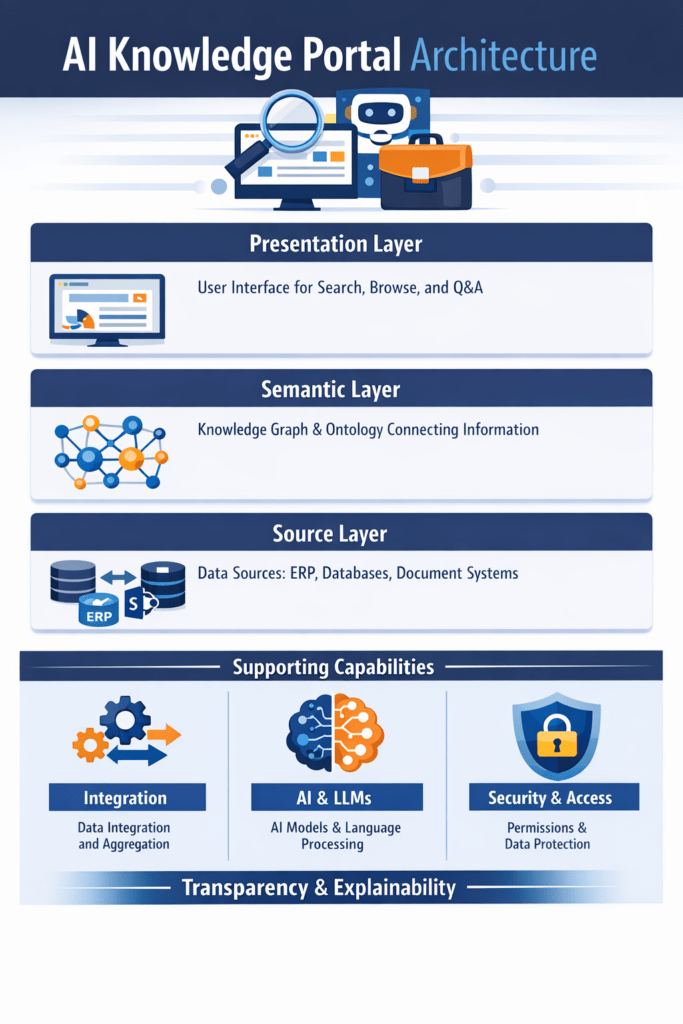
AI Knowledge Portals typically have three main layers:
1. Presentation Layer
The user interface where employees search, browse, and interact with information.
2. Semantic Layer
The core intelligence of the portal. This layer organizes relationships between people, products, documents, and other business assets using a knowledge graph and metadata.
3. Source Layer
The systems where information originally resides, such as ERP systems, document repositories like SharePoint, databases, and other operational platforms.
In addition to these layers, three important capabilities support the portal:
- Integration: connects data from multiple systems into the knowledge graph.
- Large Language Models (LLMs): power AI features such as summarization and question answering.
- Security and Access Controls: ensure users only see information they are authorized to access.
Because a knowledge portal pulls information from many systems, strong security controls are critical to prevent sensitive information from being shared unintentionally.
Interest in AI Knowledge Portals is growing quickly, and many companies are investing heavily in this space. However, the excitement around AI has also led to confusion and unrealistic expectations.
Organizations considering these solutions should focus on systems that provide transparency, explainability, and strong organizational context. The goal should not be another black-box AI tool, but a “glass box” system that clearly shows how information is connected and how answers are generated.
Done correctly, AI Knowledge Portals can transform how organizations find information, understand their operations, and make better decisions.
About the Author




Wayne, I have noticed that A. I. is inclined to strongly lean Left anytime politics or social issues are involved.
What’s up with that?
(garbage in garbage out?)
Editor’s Note: Yes, you are not hallucinating, for certain subjects, consider the source, and also what you are prompting it to do or ask about…def leans center to far left. But, my field is KM, which is what AI really excels at. The models do get better every 5 weeks though…