


Scientists at Stanford University and the Arc Institute have used artificial intelligence to design complete viral genomes that were then built in the lab and shown to work — infecting bacteria, replicating, and spreading. The findings, published August 6, 2026 in the journal Science, mark the first time a generative AI model has designed an entire functional virus genome from scratch, rather than just a single gene or protein.
What the researchers actually did
The project was led by Brian L. Hie, an assistant professor of chemical engineering at Stanford and an “innovation investigator” at the Arc Institute, together with Stanford bioengineering researcher Samuel King. The team used two AI systems, Evo 1 and Evo 2 — “genome language models” trained on genetic sequences rather than text — to generate new versions of a well-studied bacteriophage called ΦX174. Bacteriophages are viruses that infect only bacteria; ΦX174 specifically targets E. coli and has been a workhorse of molecular biology since the 1970s, when it became the first genome ever fully sequenced.
The AI produced hundreds of thousands of candidate genome sequences. Researchers synthesized and tested nearly 300 of them, and 16 turned out to be viable — meaning they could be assembled into DNA, inserted into E. coli, and produce working viruses capable of infecting cells and making more copies of themselves. The successful genomes differed from any natural phage by dozens to hundreds of genetic changes, and 13 contained mutations not found in any known natural sequence. One design incorporated a structural protein from a distantly related virus in a way earlier researchers hadn’t managed to achieve. When combined into a “cocktail,” several of the AI-designed phages overcame bacteria that had evolved resistance to the original, natural virus.
These are bacteriophages, and the containment matters as much as the target. The viruses infect only bacteria, not humans, animals, or plants, and the AI models were not trained on human-infecting viruses. Beyond that, Arc Institute has stated the work was conducted under safety protocols that went beyond standard requirements: experiments took place in dedicated biosafety cabinets with specialized disposal procedures, equipment never left the containment area, and only non-pathogenic laboratory E. coli strains were used as hosts.
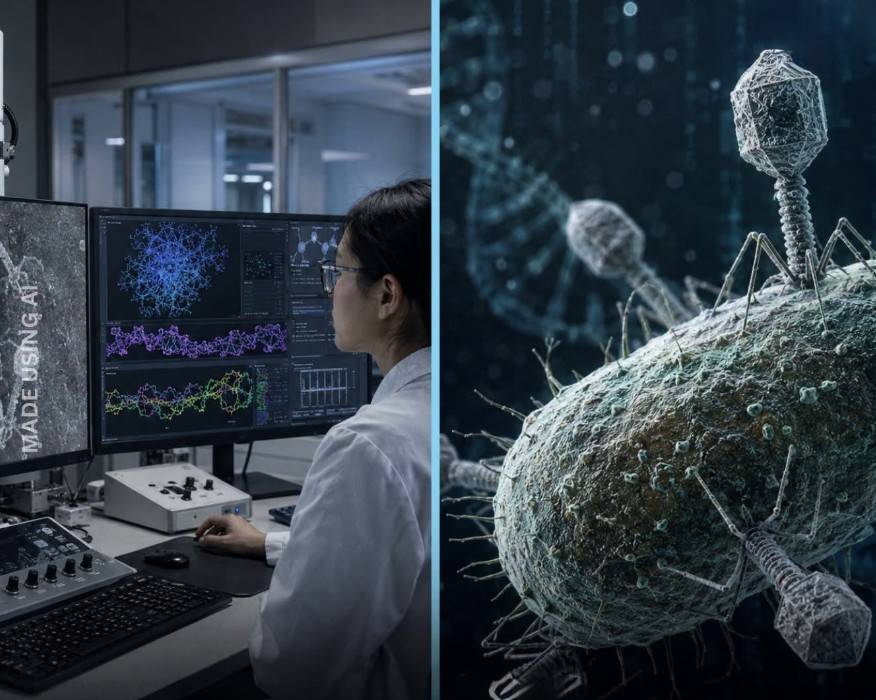
The purpose was therapeutic, not offensive. Phage therapy — using viruses to kill drug-resistant bacteria — is a decades-old idea that has struggled because it’s slow to find or engineer a phage that matches a specific infection. No phage therapy currently has full FDA approval. The researchers frame AI-generated genome design as a way to produce diverse phage cocktails faster, since resistance to a single phage can otherwise render a treatment useless.
The genuine, expert-flagged concern
Where the underlying story does raise a real and widely echoed concern is biosecurity infrastructure, not motive. Biosecurity researchers, including specialists at Johns Hopkins, have pointed out that current systems for screening commercial DNA-synthesis orders are built to catch sequences matching known natural pathogens. AI-designed genomes that are novel — different enough from anything in nature — could potentially slip past those filters. This is a structural gap in oversight, and it applies regardless of who funded any particular study. Some commentators, including a Washington Post op-ed by legal and technical scholars, have separately raised a related worry: even if this team used only bacteria-targeting models and built in strong lab safeguards, the underlying AI approach is largely open — Evo 2’s model weights, code, and training data have been published publicly — which means the barrier to someone building a similar model trained on more dangerous pathogen data is a matter of choice and effort, not a hard technical wall. Hie himself has acknowledged this concern rather than dismissing it.
This is a genuine scientific first — AI-generated, fully synthetic, self-replicating virus genomes that work in a lab — and it’s reasonable to treat it as a milestone worth scrutiny. But the responsible framing separates three distinct things that are easy to blur: (1) what was actually built (bacteria-only phages, under enhanced containment, aimed at antibiotic resistance), (2) the legitimate oversight question experts are raising (DNA-synthesis screening isn’t built for AI-novel sequences), and (3) unverified claims about funders’ motives, which shouldn’t be presented as settled fact. The science is real and the biosecurity question is real; claims that go beyond what’s documented deserve the same scrutiny as the research itself.
Sources: Stanford Report; Arc Institute; Science (DOI: 10.1126/science.aec2657); Chemical & Engineering News (C&EN); bioRxiv preprint; Xinhua.
About the Author




Sounds more like something Dr Fauci and the Chinese might have come up with..
Just watched The Terminator again on DVD last week. Welcome to A.I.
Funk this Tony Fauci and his little dog too!