
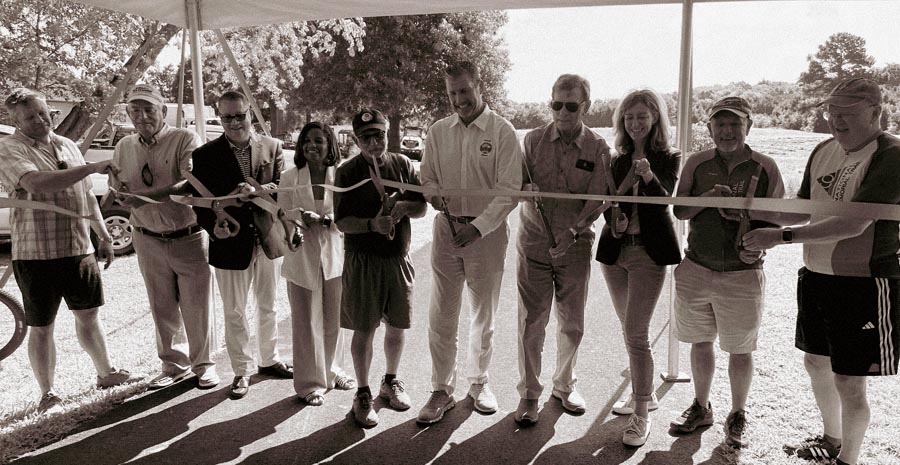
Thursday brought the ribbon-cutting for the first completed section of the Eastern Shore Rail Trail.
The newly opened portion extends a little more than two miles from the trailhead in Cape Charles to Route 13, providing a roughly 4.5-mile round trip for walkers and bicyclists. It is the first piece of a proposed 49-mile trail that would eventually stretch north to Hallwood.
The trail isn’t being built from nothing — it’s being laid directly over more than a century of railroad history. The corridor traces the former New York, Philadelphia and Norfolk Railroad line, a 96-mile route that once ran trains between Pocomoke City, Maryland, and Norfolk, Virginia. The section reaching Cape Charles was originally constructed in 1884, and the company built a freight depot, terminal, and harbor there, later developing a system of barges to ferry rail cars across the Chesapeake Bay to Norfolk.
That railroad reshaped life on the peninsula. Before it arrived, Eastern Shore towns and villages clustered around the water’s edge, and the interior of the peninsula remained largely undeveloped; once the tracks went in, farmers and seafood dealers began shipping their goods by rail, and new villages sprang up along the line and at the crossroads it created.
The line’s fortunes shifted with the broader decline of American rail freight. After the Pennsylvania Railroad’s successor, Penn Central, went bankrupt in 1970, its successor, Conrail moved to abandon the track south of Pocomoke.
In 1976, Northampton and Accomack counties stepped in, forming the Accomack-Northampton Transportation District Commission to keep the corridor running under a series of short-line operators. Freight service eventually gave out for good: the Bay Coast Railroad, the line’s last operator, announced in 2018 that it would cease operations.
Rather than let the right-of-way be sold off in pieces, the counties “railbanked” the stretch between Cape Charles and Hallwood in 2020, a designation that lets communities repurpose a rail corridor as a public trail while preserving it for future infrastructure like power, broadband, and utility lines. Groundbreaking on the first segments followed in 2025, and construction on the Cape Charles-to-Cheriton stretch began in April of that year, converting the former Bay Coast Railroad right-of-way into a shared-use path for pedestrians and cyclists.
What the Trail Means for the Community
Environmentally, the project reuses an existing transportation corridor rather than cutting a new one through farmland or forest — the same land that once carried freight cars now channels bike tires and running shoes. Repurposing the rail bed also preserves a green corridor across the peninsula, and the right-of-way remains protected so it can continue hosting the utility infrastructure that communities rely on.
Economically, local leaders see the trail as a draw for both visitors and new businesses. Ron Wolff, executive director of the Eastern Shore Rail Trail Foundation, said supporters expect the corridor to bring new businesses eager to locate along it, calling the trail an economic boost for the roughly 10 to 15 towns the finished route is expected to pass through. That’s already playing out: a local entrepreneur recently opened a bike and e-bike rental shop in Cape Charles specifically to serve trail users, with plans for a bike-share program and a repair station further up the line. Planners have also pointed to the trail’s potential to boost tourism and spur trail-adjacent development in the historic waterfront towns it will connect.
Socially, the trail is meant to knit communities together in a very literal sense. Wolff noted that beyond recreation, the trail can serve as a new mode of transportation — safe walking and biking routes that connect residents to existing STAR Transit bus routes, which he called vital for people across the Shore. For a rural peninsula with limited public transit, that connectivity can matter as much for daily errands and commuting as for weekend recreation. The Foundation has also been coordinating with both Northampton and Accomack counties on shared trail rules, and county leaders and community members turned out for the project’s 2025 groundbreaking, celebrating its promise to link towns, businesses, and parks along the way.
The Cape Charles-to-Route 13 section is just the beginning. Segments extending north toward Cheriton, Birdsnest, Melfa, and Onley are in various stages of funding and planning, with the ultimate goal of a continuous 49-mile trail from Cape Charles to Hallwood — turning a rail line that once carried the Eastern Shore’s farm goods and seafood to market into a corridor that carries its residents and visitors instead.
About the Author



Of course it's his business how much water the concrete plant uses. This is still America, afterall. And where are…
It is none of your damn business how much water the concrete plant uses. You seem like a busy body.…
According to the Cape Charles Mirror (10/11/26), in the article on “Cape Charles Advances Municipal Building, Harbor Boardwalk and Infrastructure…
Thank you very much for your prompt edit 😊
You’ve posted a photo of Eyre Hall. This can be very misleading. Please correct. Editor's Note: Thanks for the catch!…