
Seventy years before goth was a genre, a subculture or a shopping aisle, a Finnish-American dreamer from a fish cannery town walked out of the fog on Los Angeles television and invented it.
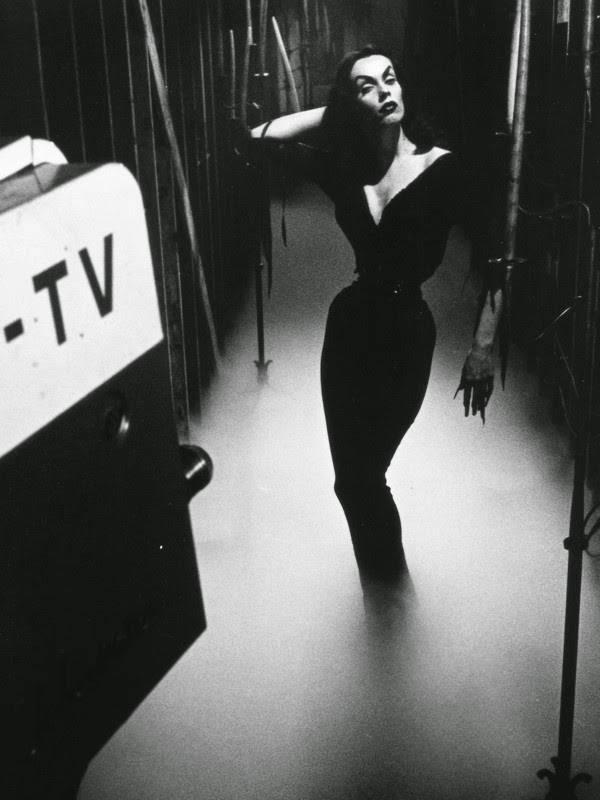
Late on a Friday night in the spring of 1954, viewers tuned to KABC-TV saw a corridor swallowed in dry-ice mist. A figure drifted toward the camera: paper-white skin, a black gown frayed at the hem, fingernails like talons, a waist so narrow it looked drawn rather than grown. She stopped, lifted her face, and screamed.
That was Vampira, the first horror host on American television. The woman inside the dress was Maila Nurmi, and the character she built from cartoons, costume-ball daring and sheer self-invention would outlive her show, her film career and, eventually, her. Her life is a story about how a pop icon is made, how quickly it can be taken away, and how long it takes for the world to give credit back.
A girl who wrote her own origin story
She was born Maila Elizabeth Syrjäniemi on December 11, 1922, in Gloucester, Massachusetts, the daughter of a Finnish immigrant father, Onni, and a mother of Finnish descent. For most of her life she told a better version: that she was born in Petsamo, Finland, and that the Olympic distance runner Paavo Nurmi was her uncle. Newspapers repeated the tale for decades, even in her obituaries. Historian W. Scott Poole later established the Gloucester birth, and comedian Dana Gould said he had seen the birth certificate. Nurmi herself admitted in her diary that the Finnish birthplace was fiction.
The family moved west, through Ohio and on to Astoria, Oregon, where she graduated from Astoria High School. There she picked strawberries, drove a bookmobile and canned tuna on the Columbia River. According to her niece and biographer Sandra Niemi, the turning point came in the bathtub, listening to Orson Welles on the radio and realizing a cannery was not going to be the whole of her life. In October 1941 she boarded a bus for Los Angeles and never returned to Astoria.
Hollywood did not open its doors at once. She danced in the chorus at the Florentine Gardens, modeled, and posed as a pin-up for Alberto Vargas. In 1944 she reached Broadway as a lady-in-waiting in Mae West’s Catherine Was Great, until West reportedly dismissed her for pulling focus. That December she appeared in Spook Scandals, a midnight horror revue, where director Howard Hawks spotted her. Hawks cast her in a planned film called Dreadful Hollow, but the project stalled so many times that she walked away from the contract.
A costume ball, and a character is born
Vampira began as a Halloween-style gamble. In 1953 Nurmi went to choreographer Lester Horton’s annual Bal Caribe masquerade dressed as the unnamed, slinky matriarch of Charles Addams’s New Yorker cartoons, the woman television would later call Morticia. Nurmi pushed the look further, adding what she described as sex and death to Addams’s dry gothic wit. She took the costume prize over a crowd of more than 2,000 people.
In the room was Hunt Stromberg Jr., program director at KABC-TV, who wanted a host to sell the station’s late-night horror reruns. He had no way to reach the mysterious ghoul, and spent months looking. He finally got her phone number through fashion designer Rudi Gernreich.
The last piece came from home. Nurmi’s husband, screenwriter Dean Riesner, supplied the name: Vampira.
Television’s first glamour ghoul
KABC aired a preview, Dig Me Later, Vampira, at 11 p.m. on April 30, 1954. The Vampira Show premiered the following night and ran weekly until April 2, 1955. Every episode opened the same way: the long walk through the fog, then the scream. Between the films, Vampira lounged among cobwebs, chatted with her pet spider Rollo, soaked in a bubbling cauldron, and invited viewers to write in for epitaphs rather than autographs.
The station sold her as hard as she sold herself. For one stunt KABC had her chauffeured around Hollywood in an open 1932 Packard touring car, sitting in the back in full costume beneath a black parasol. The show became an immediate hit. In June 1954 she appeared on The Red Skelton Show in a horror comedy sketch alongside Bela Lugosi and Lon Chaney Jr. Life magazine ran a three-page spread, and Newsweek and TV Guide followed. She was nominated for a Los Angeles-area Emmy as Most Outstanding Female Personality, and fan clubs sprang up far beyond a city that was the only place her show actually aired.
The off-screen Vampira was just as vivid. Nurmi was part of the Hollywood beatnik set and a close friend of James Dean; her niece’s biography also describes encounters with Marlon Brando and Elvis Presley, and an affair with Orson Welles that produced a son she gave up for adoption.
The fall, and Plan 9
The run lasted less than a year. In 1955 KABC canceled the show and, by one account, asked Nurmi to sign over the rights to Vampira. She refused, kept the character, and took it to rival station KHJ-TV, where a version aired in 1956. The magic did not transfer. That same autumn James Dean was killed in a car crash, and Nurmi found herself shut out of the industry, broke, and cleaning houses to get by.
She kept taking small film parts: Too Much, Too Soon, The Big Operator and The Beat Generation. Her most famous screen credit came from Ed Wood, who paid her $200 to play a silent, Vampira-like ghoul opposite Bela Lugosi in Plan 9 from Outer Space. Nurmi reportedly did her own makeup at home and rode the bus to the soundstage in costume. The film was dismissed on release and later crowned one of the worst movies ever made, which is exactly why generations of midnight-movie audiences have seen her glide through its cardboard cemetery. By the early 1960s, Vampira had all but vanished from public view.
Vampira’s Attic, and the fight over Elvira
Nurmi reinvented herself as a shopkeeper. She opened Vampira’s Attic, an antiques boutique run out of her home on Melrose Avenue. She made and sold handmade jewelry, painted Vampira portraits that became collectibles, threw herself into animal protection, and in the punk era even turned up fronting a band as Vampira.
In 1981 KHJ-TV approached her about reviving the character for a new horror-movie show. Nurmi worked with the producers and was slated for an executive producer credit, but the partnership fell apart. She later said the station had cast the lead without consulting her; she had wanted Lola Falana for the part. KHJ went ahead with actress Cassandra Peterson, and the host was renamed Elvira.
Nurmi saw her creation in Elvira’s plunging black gown and sued Peterson for $10 million, telling the Associated Press, “There is no Elvira. There’s only a pirated Vampira.” Peterson has said the two had once discussed licensing the name before talks broke down. Accounts of how the case ended differ: some reports say Nurmi lost in 1989, while others say she dropped it after running out of money for legal fees. Either way, Elvira went on to become a franchise. Nurmi went back to a small North Hollywood apartment, a cat and two birds.
The long afterlife of a glamour ghoul
Almost nothing of the original show survives. It aired live, only in Los Angeles, and was barely preserved; a rare kinescope fragment was restored for R.H. Greene’s 2012 documentary Vampira and Me. Yet the image escaped the medium. The AP credited her with pioneering the spooky-yet-sexy goth aesthetic, and many believe she shaped the look Carolyn Jones gave Morticia on The Addams Family in 1964, bringing Charles Addams’s character full circle. Bobby Bare recorded a song called “Vampira” in 1958, and punk and horror-rock bands kept her name alive for decades after.
The revival began in earnest in 1994, when Tim Burton’s Ed Wood cast Lisa Marie as Nurmi opposite Johnny Depp, introducing her to a new generation. Documentaries followed, including Finland’s About Death, Sex and Taxes (1995) and Kevin Sean Michaels’s Vampira: The Movie (2006). Nurmi authorized a model kit, a figurine and, in 2004, Vampira merchandise through Coffin Case. Scholarship arrived too: W. Scott Poole’s Vampira: Dark Goddess of Horror (2014) and Sandra Niemi’s Glamour Ghoul: The Passions and Pain of the Real Vampira, Maila Nurmi (2021).
Maila Nurmi died of natural causes at her Hollywood home on January 10, 2008, aged 85. She asked that, in lieu of flowers, donations go to an animal rescue. She is buried at Hollywood Forever Cemetery, among the stars of the industry that once forgot her. Every October, when horror hosts, goth kids and Halloween costumes fill the culture with black lace and white powder, they are walking the path she first cut through the fog.
Sidebar: Vampira at a glance
| Detail | Fact |
|---|---|
| Born | Maila Elizabeth Syrjäniemi, December 11, 1922, Gloucester, Massachusetts |
| Died | January 10, 2008, Los Angeles (age 85) |
| Character created | 1953, Lester Horton’s Bal Caribe masquerade |
| Named by | Husband Dean Riesner, screenwriter |
| The Vampira Show | KABC-TV Los Angeles, April 30, 1954 to April 2, 1955 |
| Honors | Local Emmy nomination, Most Outstanding Female Personality (1954) |
| Best-known film | Plan 9 from Outer Space, paid $200 |
| Portrayed by | Lisa Marie in Tim Burton’s Ed Wood (1994) |
| Resting place | Hollywood Forever Cemetery |
About the Author



Life is an outlet for my imagination, E. Dickenson. Cape Charles, which I think is quite unique, as it is…
I must say that election season provides a great deal of entertainment bang for the buck. Ideas, opinions, rants, complaints,…
Something tells me that you have rarely, if ever, even visited Cape Charles. This is just an outlet for your…
Not for nothing is Frank Wendell a cultural icon in Cape Charles, E. Dickenson! Something to think about as you…
Beauty, E. Dickenson, is in the eye of the beholder, and quite obviously and transparently, from your comment about what…