


A new report from Microsoft suggests that artificial intelligence is rapidly becoming part of daily life in America’s cities — but many rural communities are being left behind.
The report, based on county-level data across the United States, found that working-age Americans living in large urban areas are nearly twice as likely to use AI tools as residents in rural communities. According to the findings, nearly one-third of people in major cities now use AI, compared with just 16.2% of rural residents.
Microsoft President Brad Smith warned that the widening gap could deepen existing economic and educational divides between urban and rural America.
“It’s very unfortunate if the people who could benefit from it the most — who arguably need it the most — are accessing generative AI less frequently,” Smith said in an interview discussing the report.
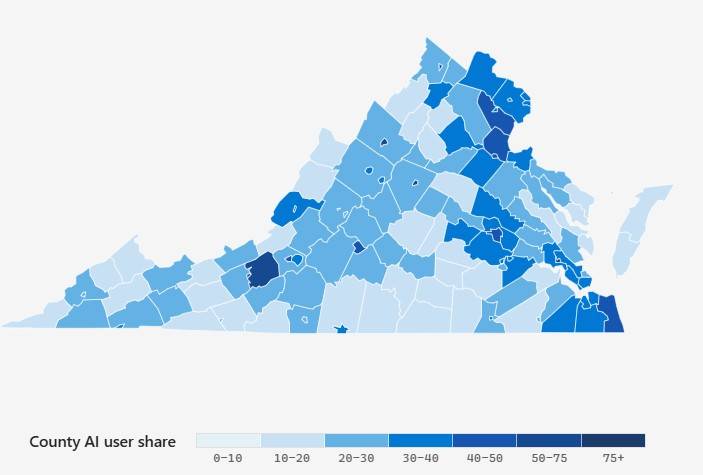
The findings also suggest that trust in AI differs sharply depending on where people live. More than half of urban respondents said they believe AI is likely to act in the public interest, while fewer than 40% of rural residents expressed the same confidence.
Smaller cities fell somewhere in the middle, with about 22% of residents reporting regular AI use.
Among the nation’s 35 largest metropolitan areas, usage rates varied widely. Washington, D.C., posted the highest adoption rate at nearly 40%, while Pittsburgh ranked among the lowest at just over 25%.
The report highlights college towns as major AI hotspots. Every county ranked among the top 15 for AI adoption was home to a college or university, reinforcing the role higher education appears to play in introducing people to emerging technologies.
At the same time, Smith acknowledged that the technology industry bears some responsibility for the gap.
“We have to understand people’s problems. We have to make the case and we have to make the products useful and easy for people to use,” Smith said. “We have a lot of work to do.”
The report may carry particular importance for rural regions such as Virginia’s Eastern Shore, where access to advanced technology training and digital infrastructure can be more limited than in major metropolitan areas. Supporters of broader AI adoption argue that the technology could help small towns and rural businesses improve productivity, expand educational opportunities, strengthen healthcare access, and support economic development.
Top 10 counties (highest share):
- #1Williamsburg city Metropolitan 73.2%
- #2Harrisonburg city Metropolitan 67.5%
- #3Lexington city Micropolitan 63.5%
- #4Charlottesville city Metropolitan 51.7%
- #5Montgomery County Metropolitan 50.8%
- #6Fredericksburg city Metropolitan 49.3%
- #7Radford city Metropolitan 48.5%
- #8Lynchburg city Metropolitan 48.0%
- #9Richmond city Metropolitan 44.6%
- #10Prince William County Metropolitan 44.4%
Bottom 10 counties (lowest share)
- #124Northumberland County Rural 14.2%
- #125Charlotte County Rural 14.1%
- #126Nottoway County Rural 13.9%
- #127Highland County Rural 13.8%
- #128King and Queen County Metropolitan 13.7%
- #129Accomack County Rural 13.6%
- #130Northampton County Rural 13.4%
- #131Grayson County Rural 13.3%
- #132Patrick County Rural 13.0%
- #133Cumberland County Rural12.9%
Smith said the issue is not simply about technology companies gaining more users, but about whether AI ultimately widens or narrows economic inequality across the country.
“I think that it is an imperative for the tech sector not only to make the case, but to heed the importance of building AI in a way that gives people the opportunity to pursue better jobs,” Smith said.
As AI tools increasingly shape workplaces, education, and public services, the report suggests that communities unable or unwilling to adopt the technology may risk falling further behind in an economy that is rapidly changing.
About the Author




Common sense would explain the difference. Funk AI and the people who developed it.
Per the White House website, President Trump advocates for the use of AI. If it is good enough for Donald J. Trump, it is good enough for America!
Funk him too.
Hear, Hear! Let the loser Libs suck on that! If you oppose our president it just proves your a commie!!!!