
RICHMOND, Va. — Virginia will invest $2 million over the next two years to study Atlantic menhaden in the Chesapeake Bay, ending years of unsuccessful attempts to fund independent research into one of the Bay’s most contentious fisheries.
The funding was included in the Commonwealth’s final two-year budget after an amendment proposed by Gov. Abigail Spanberger was approved by the General Assembly. The appropriation directs the Virginia Institute of Marine Science (VIMS), working in collaboration with the Virginia Marine Resources Commission (VMRC), to conduct research aimed at improving scientific understanding of the Bay’s menhaden population.
The study comes as environmental organizations, recreational anglers, commercial fishermen, and the menhaden industry continue to debate whether existing coastwide fish population assessments accurately reflect conditions within the Chesapeake Bay.
Atlantic menhaden are a small, oily forage fish that serve as a primary food source for numerous predators, including striped bass, bluefish, weakfish, dolphins, and ospreys. They also support Virginia’s reduction fishery, in which fish are harvested and processed into fishmeal and fish oil.
Virginia remains the only East Coast state that allows industrial menhaden reduction fishing. Ocean Harvesters, which supplies Omega Protein’s processing facility in Reedville, is permitted to harvest up to 112 million pounds of menhaden annually from the Chesapeake Bay using purse seine nets.
Environmental advocates have argued for years that localized depletion of menhaden within the Bay may be contributing to declines in predator species, particularly struggling osprey populations. They contend that coastwide stock assessments conducted by the Atlantic States Marine Fisheries Commission may overlook regional shortages within the Chesapeake Bay.
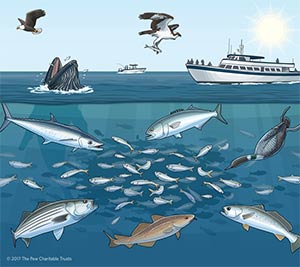
A recent study published in Frontiers in Marine Science found that reduced access to menhaden was a primary factor behind poor osprey reproductive success in portions of the Bay during the 2024 nesting season, adding new urgency to calls for localized research.
“This is a solid down payment on urgently needed research,” said Will Poston, forage campaign manager for the Chesapeake Bay Foundation. “Unfortunately, many questions remain about the health of the Bay’s menhaden population and the iconic species such as osprey that depend upon it. This is precisely why independent science on menhaden in the Bay is so important.”
The Chesapeake Bay Foundation has long argued that watermen, recreational anglers, birdwatchers, and residents have reported seeing fewer schools of menhaden and declining osprey colonies, prompting repeated requests for dedicated scientific study.
The fishing industry, however, maintains that there is no evidence menhaden are being overfished and says management decisions should continue to rely on sound scientific data rather than anecdotal observations.
Ocean Harvesters CEO Monty Deihl welcomed the new funding, saying the company has consistently supported additional research.
“We are extremely pleased” that the budget includes funding for a Chesapeake Bay menhaden study, Deihl said in a statement. He said Ocean Harvesters looks forward to working with VIMS and VMRC to develop a comprehensive scientific assessment of the Bay’s menhaden population.
Deihl noted that the new state-funded effort will complement an ongoing project led by the National Science Foundation-supported Science Center for Marine Fisheries. That initiative, funded in part by Ocean Harvesters and Omega Protein, is developing a research roadmap involving scientists from VIMS, the University of Maryland Center for Environmental Science, Chesapeake Biological Laboratory, and NOAA to identify data gaps and improve management of the fishery.
Despite sharp disagreements over the health of the Chesapeake Bay’s menhaden population, both the Chesapeake Bay Foundation and Ocean Harvesters praised the funding, calling for decisions to be guided by improved scientific information.
The budget amendment also directs Virginia’s economic and workforce development agencies to study the potential economic impacts of future reductions to the Chesapeake Bay harvest cap, including effects on employment and the regional seafood industry.
Supporters of the study say the investment could provide the independent scientific data needed to answer longstanding questions about the Bay’s menhaden population and help inform future management decisions balancing ecological concerns with the economic importance of Virginia’s commercial fishery.
The research is expected to begin during the current biennium, with findings intended to support future decisions by state and interstate fisheries managers regarding harvest limits and long-term conservation of one of the Chesapeake Bay’s most important forage species.
About the Author



Of course it's his business how much water the concrete plant uses. This is still America, afterall. And where are…
It is none of your damn business how much water the concrete plant uses. You seem like a busy body.…
According to the Cape Charles Mirror (10/11/26), in the article on “Cape Charles Advances Municipal Building, Harbor Boardwalk and Infrastructure…
Thank you very much for your prompt edit 😊
You’ve posted a photo of Eyre Hall. This can be very misleading. Please correct. Editor's Note: Thanks for the catch!…