
Long before the honeybee arrived on a colonial ship, Virginia’s wild gardens were already humming.
Walk through a Virginia meadow in late summer and you’ll notice something that most people overlook entirely: the bees working the goldenrod are not the bees working the asters, which are not the bees on the mountain mint. Each flower has its regular. Each bee has its allegiance. This is not coincidence — it is the result of tens of millions of years of co-evolution between native bees and the plants that grew up alongside them.
Virginia is home to more than 400 documented native bee species — and according to the Virginia Department of Conservation and Recreation’s Natural Heritage Program, which recently completed the first comprehensive inventory of the state’s bees, the true count may reach 456 native species. Most Virginians have never heard of them. Many have never thought to look.
When people learned that bees were in trouble, many rushed to keep honeybees. It seemed like the right impulse. But the honeybee (Apis mellifera) is not native to North America. It arrived from Europe in the early 1600s, a colonial import as thoroughly non-native as the dandelion. More honeybees in a landscape mean more competition for the bees that actually belong here — the mason bees and miner bees, the carpenter bees and leafcutters and orchard bees that evolved on this continent alongside its native plants and are, in many cases, far superior pollinators.
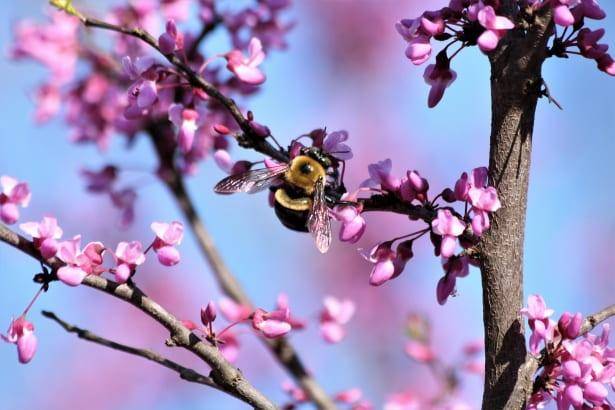
These native bees are generalists and specialists, ground-dwellers and wood-nesters, early risers and late-season stragglers. They work flowers that honeybees ignore, pollinate crops that commercial beekeeping cannot serve, and sustain native plant communities that would collapse without them. They are woven into the fabric of Virginia’s ecosystems at a level that a European import, however industrious, cannot replicate.
Meet Some Of Virginia’s Native Bees
Mason Bees (Osmia spp.)
Named for their habit of sealing nest chambers with mud, mason bees are small, often iridescent blue or green, and among the most effective pollinators of fruit trees anywhere in the world. They are active in spring — precisely when orchards bloom — and are credited as outstanding pollinators of apricots, almonds, apples, blueberries, cherries, peaches, pears, and plums. A single mason bee can do the pollination work of dozens of honeybees because she carries pollen dry, on her belly, where it falls freely onto flower parts as she moves.
Mason bees are solitary. A female locates a ready-made cavity in wood, a hollow stem, or a crack in stone, provisions it with a ball of pollen and nectar, lays a single egg, and seals the cell with mud. She repeats this along the length of the cavity, then moves on. She will never meet her offspring. There are more than 20 native mason bee species in the mid-Atlantic region — though, notably, one of the most commonly collected species in recent years is Osmia taurus, an invasive mason bee first recorded in West Virginia and Maryland in 2002 that has spread rapidly through the region, displacing native species.
Miner Bees (Andrena spp. and related genera)
Miner bees are ground-nesters, excavating tunnels anywhere from one inch to a foot or more beneath the surface, lining their brood chambers with a waterproof secretion that can withstand seasonal flooding. They are cold-hardy — one of the earliest bees to emerge each spring, often appearing while frost still lingers — and they are among the most important early-season pollinators of wildflowers, trees, and early vegetables.
Many miner bees are specialist feeders, meaning they collect pollen from only one genus or family of plants. The spring beauty miner bee (Andrena erigeniae) forages almost exclusively on spring beauty (Claytonia virginica). The golden alexanders miner bee is tied to golden alexanders (Zizia aurea). Remove those plants from the landscape and the bee — which cannot simply switch to something else — disappears with them.
Carpenter Bees (Xylocopa virginica)
The eastern carpenter bee is large, loud, and frequently misunderstood. Males — the ones hovering aggressively near porches and eaves — are all bluster. They have no stingers. Females, which do possess stingers, rarely use them unless directly handled. These bees are valuable native pollinators, particularly effective at a technique called “buzz pollination” or sonication: grasping a flower and vibrating their flight muscles at just the right frequency to shake loose pollen that would otherwise remain locked inside tubular anthers. Tomatoes, blueberries, and eggplants all benefit enormously from buzz pollination — a service that honeybees, which lack this ability, simply cannot provide.
Carpenter bees excavate their own nest galleries in untreated wood, which sometimes puts them at odds with homeowners. But they are, ecologically, a keystone species in Virginia’s native ecosystems.
Leafcutter Bees (Megachile spp.)
If you’ve noticed the neat, circular cutouts in the leaves of your redbud or rose, you’ve found evidence of a leafcutter bee at work. These bees snip discs of leaf material — sometimes from roses, but with a particular fondness for redbud (Cercis canadensis) — and carry the pieces back to line and cap their nest cells. The result is a series of leaf-wrapped packages, each containing a single egg atop a ball of pollen.
Leafcutter bees are solitary, nesting in pre-existing cavities in rotting wood, hollow stems, or other tunnels they discover. They are generalist pollinators of fruits, vegetables, and wildflowers, and some species are commercially managed for alfalfa pollination. They are mid- to late-season bees, active through summer into fall.
Bumblebees (Bombus spp.)
Virginia’s bumblebees are among its most charismatic native insects — and among its most imperiled. Unlike the solitary species above, bumblebees are social, forming annual colonies of dozens to several hundred workers under the direction of a single queen. They are powerful buzz pollinators and long-distance foragers, capable of working flowers in cool temperatures and low light that ground other bees.
The eastern bumblebee (Bombus impatiens) remains common across Virginia. But several other species have declined catastrophically. The American bumblebee (Bombus pensylvanicus) has seen an 89 percent population decline. The rusty-patched bumblebee (Bombus affinis) — once common in Virginia, documented at sites from Fauquier County to the Appalachian highlands — has lost roughly 90 percent of its former range since the 1990s and became the first bee listed as a federally endangered species under the Endangered Species Act in 2017. The variable cuckoo bumblebee (Bombus variabilis) is considered critically endangered by the IUCN and presumed extirpated from Virginia entirely. The yellow bumblebee (Bombus fervidus) is listed as vulnerable.
In December 2024, the U.S. Fish and Wildlife Service proposed designating parts of Bath and Highland Counties in Virginia — along with lands in West Virginia — as critical habitat for the rusty-patched bumblebee, a step that advocates have called vital to preventing the species’ extinction.
Sweat Bees (Halictidae family)
Small, often brilliantly metallic green or blue, sweat bees are among the most abundant and diverse native bees in Virginia. They are named for their occasional habit of landing on skin to gather salt from perspiration — an odd but harmless behavior. Sweat bees include both solitary and semi-social species, and they are active across a long season, making them important pollinators of a wide range of native plants and garden crops.
Orchard Bees and Others
The term “orchard bee” is sometimes applied broadly to mason bees active during fruit tree bloom, but Virginia also hosts squash bees (Eucera and Peponapis spp.), which are specialist pollinators timed precisely to the flowers of cucurbits — squash, pumpkins, zucchini — and which are often active before sunrise, working blooms that close by midmorning. The southeastern blueberry bee (Habropoda laboriosa) is another specialist, emerging each spring in synchrony with blueberry bloom and providing buzz pollination that dramatically increases fruit set.
Plaster bees, digger bees, cuckoo bees — Virginia’s native bee fauna spans families and ecologies that most people never encounter and could not name, yet all of them contribute to the pollination web that sustains Virginia’s native plant communities, agricultural crops, and wildlife food chains.
The Native Plant Connection
The relationship between native bees and native plants is not merely beneficial — for many species, it is obligatory.
Roughly 20 percent of Virginia’s native bees are specialists, meaning their young can only be provisioned with pollen from specific plant genera. The life cycles of these bees are synchronized, sometimes to within a matter of days, with the bloom times of their host plants. This co-evolution is precise and fragile. When a native plant disappears from a landscape, the specialist bees that depend on it often disappear as well, even if other flowers are abundant.
Goldenrods (Solidago spp.) support 42 species of pollen-specialist bees that rely on goldenrod pollen to provision nests for their young, in addition to attracting hundreds of generalist pollinators. Goldenrod blooms late in the season — August through October — filling a critical gap when other flowers have faded. Asters (Symphyotrichum spp.) and sunflowers (Helianthus spp.) are similarly vital, particularly for the specialist bees of the Colletidae family, which emerge in late summer and fall and depend almost entirely on the Asteraceae family.
Virginia’s native oaks are surprisingly essential — supporting the caterpillars that birds feed to their young, providing leaf litter for ground-nesting bees, and offering early pollen in spring when little else is available. Redbuds (Cercis canadensis) bloom in early spring before most trees leaf out, providing critical early-season nectar and pollen. Wild bergamot (Monarda fistulosa), mountain mint (Pycnanthemum spp.), and native coneflowers (Rudbeckia and Echinacea spp.) draw in long-tongued bees that can reach deep into tubular flowers. Blueberries (Vaccinium spp.) — with 12 native species in Virginia — are essential to a suite of specialist bees, including the southeastern blueberry bee, whose emergence is timed precisely to their bloom.
The relationship runs in both directions. Specialist bees are often more efficient pollinators of their host plants than generalists because they evolved together. The bees benefit from reliable forage; the plants benefit from reliable, species-specific pollination. This is what co-evolution looks like — partnership written in pollen, refined over millions of years.
Non-native ornamental plants, however beautiful, frequently fail these bees. Flowers bred for double blooms may be unrecognizable to pollinators and offer no pollen at all. Exotic species lack the chemical and structural signatures that specialist bees have evolved to detect. A yard full of non-native plants may look like habitat and function as a desert.
The Pressures They Face
Virginia’s native bee fauna is under siege on multiple fronts.
About 20 of Virginia’s native bee species are currently listed as globally or state rare, and according to the Center for Biological Diversity, more than half of native bee species in North America are in decline — with one in four at risk of extinction. The causes are interconnected and mutually reinforcing.
Habitat loss is primary. The expansion of agriculture, suburbanization, and the transformation of once-diverse landscapes into mowed lawns and parking lots has eliminated both nesting sites and forage. Ground-nesting bees — the majority of Virginia’s native species — need undisturbed bare soil. Cavity nesters need dead wood and hollow stems. Specialist bees need their host plants. When these elements vanish from the landscape, the bees cannot simply adapt.
Pesticides, particularly systemic neonicotinoids, present a pervasive threat. Even at sublethal doses, these compounds interfere with bees’ central nervous systems, impairing navigation, memory, and reproduction. Ground-nesting bees are especially vulnerable to pesticides that persist in soil. A 2025 global synthesis of data from 681 crop fields across three continents confirmed that pesticide use and habitat loss each independently reduce wild bee abundance and species richness — and that natural habitat does not buffer against the effects of pesticide exposure.
Disease and parasites have devastated some species. The rusty-patched bumblebee’s collapse is linked in part to a pathogen called Nosema bombi, which appears to have spread into wild populations from commercial bumblebee operations. Once a disease like this enters a small, fragmented population, it can spiral quickly toward local extinction.
Climate change is reshuffling the timing of bloom and emergence. When flowers bloom before the bees that depend on them have emerged — or when bees emerge before their food plants flower — the ancient synchrony breaks down. Specialist bees, with their narrow ecological tolerances, are most vulnerable to these mismatches.
Competition from non-native species adds another layer. The European honeybee, when kept in high densities, competes with native bees for floral resources. Some non-native mason bees and leafcutters introduced for commercial pollination have established wild populations that crowd out their native counterparts.
What Can Be Done — Starting in Your Own Yard
The good news is that native bees respond well to habitat restoration, even at small scales. Unlike large wildlife that need vast territories, many native bees have foraging ranges of a few hundred feet. A single yard planted with native species can support dozens of bee species.
The most effective action any Virginian can take is to plant native species and let them grow. Goldenrods, asters, mountain mint, coneflowers, wild bergamot, native sunflowers, and redbud are all exceptional pollinator plants. Choose species that bloom across the full season — from early spring redbuds and willows through the fall goldenrod-and-aster corridor. Plant in clumps rather than scattered single specimens, so bees can find and efficiently work the flowers. Avoid cultivars with double blooms, which frequently produce no pollen.
Leave bare soil patches for ground-nesting bees. Leave dead stems standing through winter — they are nest sites. Leave leaf litter undisturbed. Reduce or eliminate pesticide use. Resist the urge to “tidy up” in ways that destroy the habitat structure native bees depend on.
Support native habitat at the community level — advocate for reduced mowing along roadsides, native plantings in parks and public spaces, and policies that protect natural areas from development.
And pay attention. Once you begin to look for Virginia’s native bees, they appear everywhere — on the spring beauties, in the hollow stems, at the blueberry blossoms. They were always there. They were part of this place long before we were.
Virginia’s native bee species are documented through the Virginia Department of Conservation and Recreation’s Natural Heritage Program, the Virginia Tech Insect Collection, and ongoing surveys coordinated through the Smithsonian Institution and the Xerces Society. The Bumble Bee Watch citizen science project accepts observations from Virginia residents year-round.
About the Author



It is none of your damn business how much water the concrete plant uses. You seem like a busy body.…
According to the Cape Charles Mirror (10/11/26), in the article on “Cape Charles Advances Municipal Building, Harbor Boardwalk and Infrastructure…
Thank you very much for your prompt edit 😊
You’ve posted a photo of Eyre Hall. This can be very misleading. Please correct. Editor's Note: Thanks for the catch!…
Issue #1: This statement lacks clarity about the treatment process for drinking water in Cape Charles, VA: The measurements presented…