
As families continue to head to beaches during the peak of summer, the Virginia Department of Health is encouraging residents to check water quality conditions before taking a swim.
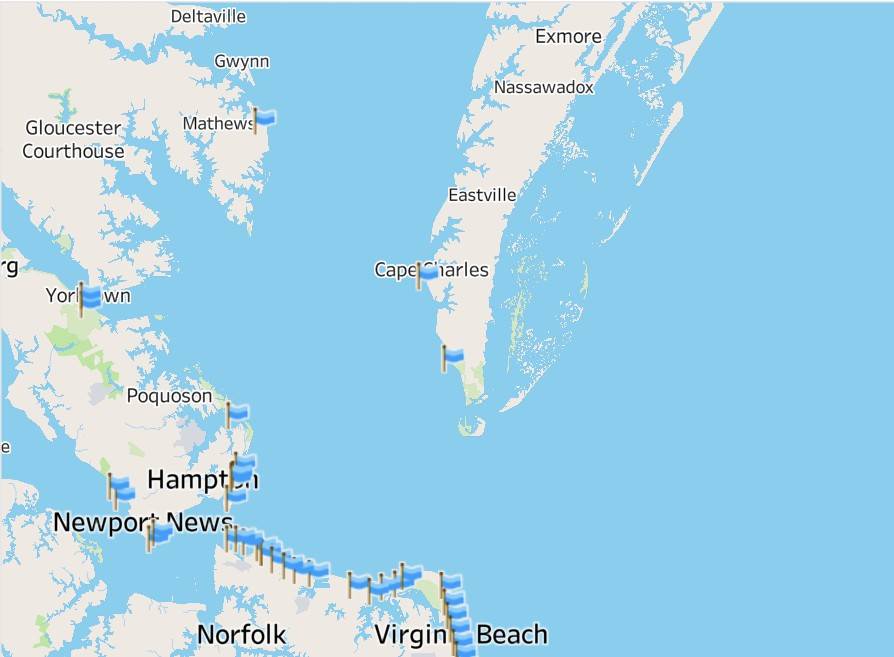
The agency maintains an interactive online map that tracks bacteria monitoring at public beaches across Virginia during the swimming season, which runs from May through September. The map allows users to zoom in on specific beaches and view the latest sampling results before visiting.
The map uses a simple color-coded system to indicate water conditions:
- Blue flag: Bacteria sample results are within the safe range for swimming.
- Red triangle: Bacteria levels exceed established health standards, and a swimming advisory has been issued.
- Yellow triangle: Sampling was not conducted, such as during severe weather or other circumstances.
- Gray circle: The seasonal monitoring period has ended, and routine sampling is no longer taking place.
VDH monitors for enterococci, a group of bacteria used as an indicator of fecal contamination in recreational waters. While the bacteria themselves are not typically harmful, elevated levels suggest that other disease-causing microorganisms may be present, increasing the risk of illness for swimmers.
People exposed to contaminated recreational waters may experience symptoms including vomiting, diarrhea, stomach pain, skin rashes and wound infections. Health officials recommend avoiding swallowing water while swimming, staying out of the water for several days after heavy rainfall, and avoiding areas near storm drains, pipes or visible pollution.
In addition to beach monitoring, VDH also operates an interactive Harmful Algal Bloom (HAB) Surveillance Map from May through October. The map identifies active algal bloom advisories across the Commonwealth and includes an online reporting form for residents who observe suspicious algae or discolored water. Harmful algal blooms can produce toxins that pose risks to people and pets.
Health officials recommend checking both the beach monitoring map and the algal bloom map before heading to the beach or other recreational waters, particularly during the warmer months when bacteria levels and algal blooms are more likely to occur.
Residents can access the beach monitoring map through the Virginia Department of Health’s Swimming Advisories and Monitored Beaches Map and view current algal bloom advisories on the Harmful Algal Bloom Surveillance Map. The algal bloom page also includes a form for reporting suspected blooms to state health officials.
About the Author




Look's like Cape Charles is planning ahead. With the potential expansion into Northampton County and more than a Tenfold increase…
Duh... First, we'll kill the Menhaden and enrich Omega and their Politician friend$. Then, the Chesapeake Bay and all of…
A southern democrat.
Hey "Bob" I take your comment as if this was coming from an idiot. How about using your real name…
A free ride to a polling place to act like an American. Of course someone has an issue with it.